
Global College of Science and Technology
An Unit of National Centre for Development of Technical Education (NCDTE) Affiliated to MAKAUT, West Bengal | Formerly WBUT | College Code: 345 | AISHE Code: C-52844
An Unit of National Centre for Development of Technical Education (NCDTE) Affiliated to MAKAUT, West Bengal | Formerly WBUT | College Code: 345 | AISHE Code: C-52844

It is my privilege to welcome you to the Department of Medical Laboratory Sciences (BMLS) at Global College of Science and Technology.
Medical Laboratory Science lies at the heart of modern healthcare — a large majority of clinical decisions rely on laboratory investigations, and it is our laboratory professionals who make accurate, timely diagnosis possible. Our department is committed to training students not merely to operate instruments, but to think critically, work ethically, and serve patients with precision and care.
Our curriculum, aligned with the National Commission for Allied and Healthcare Professions (NCAHP) guidelines, blends strong theoretical foundations with extensive hands-on practice in our well-equipped laboratory. Students gain experience across biochemistry, haematology, microbiology, histopathology, transfusion medicine, and molecular diagnostics, culminating in a structured clinical internship that prepares them for real-world hospital and diagnostic-laboratory environments.
I encourage every student to make full use of the department’s laboratories, faculty expertise, and industry linkages, and to approach their training with curiosity, discipline, and a spirit of service. I look forward to guiding you through this journey towards a rewarding career in healthcare diagnostics.
PROGRAMS | Intake Capacity | YEARS | SEMESTER | ELIGIBILITY CRITERIA |
|---|---|---|---|---|
Bachelor in Medical Laboratory Science Technology (BMLS) | 60 Seats | 4
| 8
| 1. Academic Qualification:
Passed 10+2 (or equivalent) examination with a minimum of 50% aggregate marks in Physics, Chemistry, and Biology (compulsory), along with English as a qualifying subject. Must have cleared both Theory and Practical in the above subjects.
2. Entrance Exam:
Must have a valid rank/score in NEET (National Eligibility cum Entrance Test), or admission as per NCAHP / State merit-based guidelines.
Note – Eligibility criteria are subject to revision by the regulatory authority (NCAHP). |
Graduates of the BMLS programme, as outlined in the NCAHP curriculum framework, may pursue a wide range of career pathways in the healthcare and diagnostics sector:
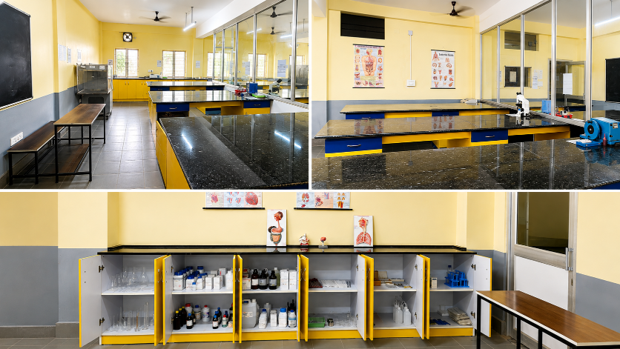
The BMLS laboratory at GCST is organised into dedicated bays for general practicals, core diagnostics, microscopy and histopathology, sample processing and sterilisation, and molecular biology and sterile handling — with granite-top workstations, glass-partitioned instrument bays, wall-mounted anatomical charts, and a fully stocked reagent/glassware storage unit. The layout supports simultaneous batch practicals while keeping instrument bays visually and physically separated from wet-bench work.
The Department of Medical Laboratory Sciences actively promotes research and innovation by encouraging faculty members to undertake quality research and disseminate their work through reputed academic platforms. The department has made scholarly contributions through research papers, book chapters, and reviews published in reputed national and international journals and publications by faculty members. These achievements reflect the department’s commitment to advancing knowledge, fostering innovation, and strengthening its research profile across biochemistry, microbiology, immunology, and allied diagnostic sciences.
Admissions Open! Get in Touch.